
A thought experiment in electron spin
What if spin were
really spinning?
Moving charge makes magnetism. Could an electron’s magnetic moment come from an ordinary spinning object?
Give the idea a shape. Then put it to the test.
A charged solid sphere.
Charge fills the volume uniformly.
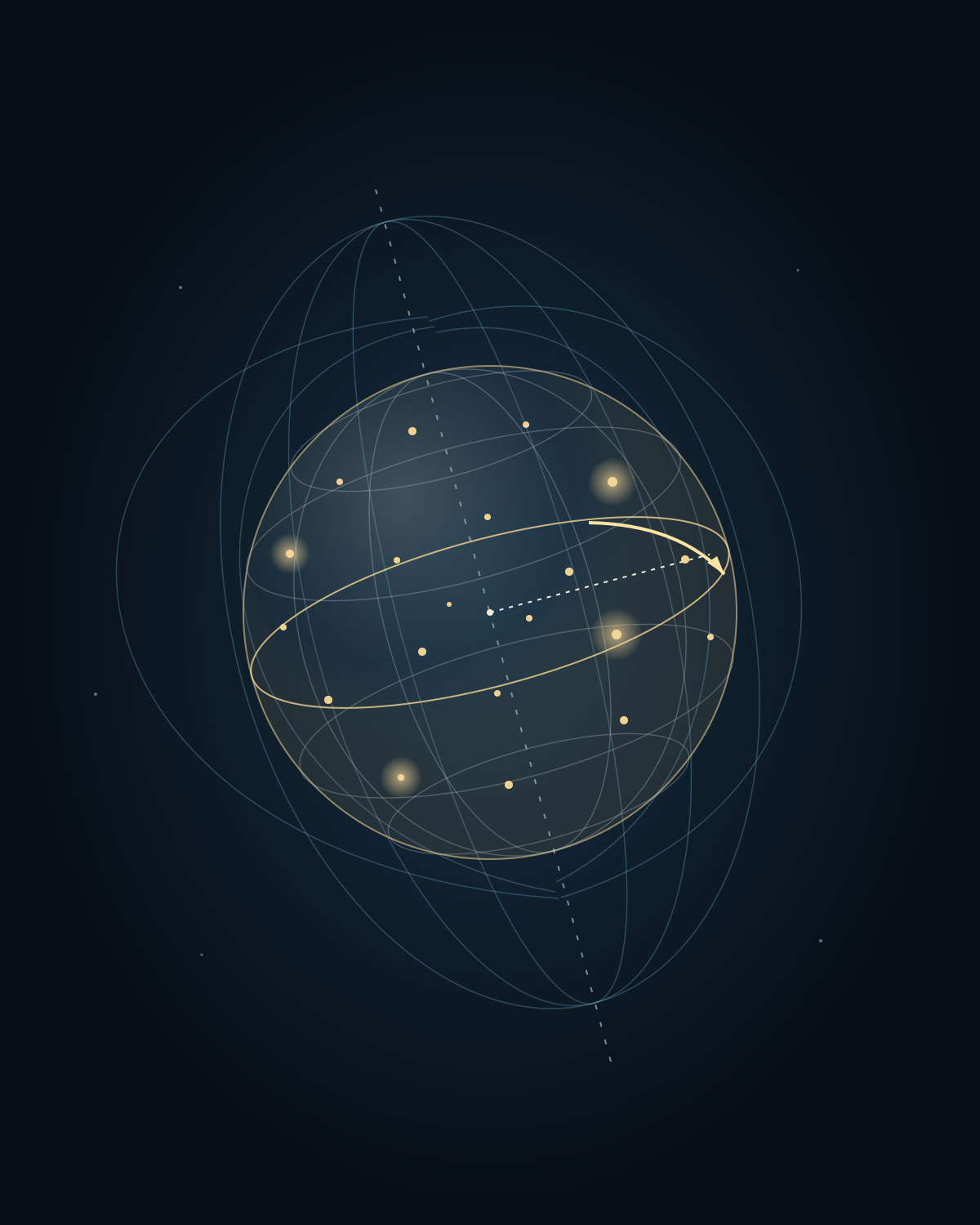
Field guides are schematic, not a field solver.
This is a test of an ordinary rotor. The calculation is nonrelativistic and becomes unreliable near c. A result below c does not establish a model of the electron. Nothing here simulates matter rotating faster than light.
Quantum experiments are in a separate lab. This page tests the classical rotor only. For the spin of light, spin zero and measurements in a row, open the Quantum Spin Lab.
Follow the consequences
Bigger helps.
But it doesn’t solve spin.
Increase the radius by ten and the required equator speed falls by ten. Changing the shape changes the number, too. Neither change repairs every mismatch with the electron.
With charge and mechanical mass distributed together, all four rotors give g = 1. The electron’s value is about twice that. This comparison omits electromagnetic field and stress contributions.
Quantum spin is intrinsic angular momentum. Its magnetic coupling predicts real measurements without assigning the electron a little rotating surface.
The reasoning, in the open
Look under the model.
What is being held fixed?
The target is the magnitude of the electron’s magnetic moment along an axis in a spin eigenstate: gₛ μB / 2, about 1.001159652 μB. The total model charge is −e. We choose a geometry and radius, then solve the ordinary classical formula for the rotation rate needed to reach that target.
The conventional classical electron radius is rₑ ≈ 2.81794 × 10⁻¹⁵ m. It is a useful scale built from physical constants, not a measured edge of a material electron. Using it here is an explicit assumption. Increasing R does not reveal the electron’s actual size.
The drawing uses a fixed display radius and a deliberately slow, fixed rotation rate so that every shape remains legible. Gold markers sample continuous negative charge; they are not separate electrons. Blue guides suggest a dipole-like magnetic field. They do not show an exact near-field solution, field strength, or a quantum electron.
The calculation and four geometries
Let k = ⟨r⊥²⟩ / R² describe how the charge is distributed away from the rotation axis. The equator speed is v = ωR. Integrating the current gives:
|μz| = eωkR² / 2
| Geometry | k | |μz| |
|---|---|---|
| Solid sphere | 2/5 | eωR²/5 |
| Spherical shell | 2/3 | eωR²/3 |
| Thin disk | 1/2 | eωR²/4 |
| Thin ring | 1 | eωR²/2 |
Using μB = eℏ/(2mₑ), rₑ = αℏ/(mₑc), and the measured-axis target |μz| = gₛ μB/2 gives:
v/c = [gₛ / (2kα)] × (rₑ/R)
For the solid sphere at R = rₑ, this is 342.987…, or about 343 times c. The impossible value is a contradiction in this ordinary model at the assumed radius. It is not a physical prediction that electron matter outruns light. These comparisons do not rule out every possible extended or field model.
For the g-factor comparison only, the mechanical mass is distributed in the same way as the charge. Then I = kmₑR² and μz = −(e/2mₑ)Lz, so g = 1. The quantum relation is μ = −gₛ(e/2mₑ)S. The chosen target does not identify a classical mechanical rotation with quantum spin.
Sources, constants and limits
Constants use the 2022 CODATA adjustment: α⁻¹ = 137.035999177, rₑ = 2.8179403205 × 10⁻¹⁵ m, and positive g-factor magnitude gₛ = 2.00231930436092. NIST lists the electron g factor using a signed convention. The displayed digits aid comparison; this experiment is not a precision measurement.
- NIST / CODATA: fundamental physical constantsNumerical constants and conventions.
- V. Kaplunovsky: rotating charged sphere derivationClassical current and magnetic moment; university course solutions.
- C. T. Sebens: How Electrons SpinWhy the speed and g-factor objections depend on the model. Its field interpretation is not assumed here.
- R. Fitzpatrick: Quantum Mechanics, spin angular momentumIntrinsic spin and magnetic coupling.
Rigid rotation, a continuous uniform charge distribution and ordinary nonrelativistic electrodynamics are idealizations. No relativistic deformation, internal stress, field angular momentum, radiation dynamics or quantum wavefunction is calculated. A sub-light result alone does not make these assumptions valid.
Keyboard, motion and privacy
Use Tab to reach each control, the arrow keys to choose a geometry or adjust the radius slider, and Enter or Space to activate buttons. Pause freezes the illustration; it does not change the calculation. The illustration starts paused when your system requests reduced motion, and stops drawing while the page is hidden.
Results are also written as text. The diagram adds no information needed to operate the calculation. The model runs in your browser using local assets, with no accounts, trackers or external code. Normal hosting logs are described in the privacy notice.