
Charge, Fields & Light Lab · Electrostatics and electrodynamics
How does one charge
reach another?
Electric charge pushes and pulls across empty space, rearranges itself in materials, and, when it is shaken, makes light.Each experiment answers one question. Change the settings and see for yourself.
Forces & Fields
The force law, how well it has been tested, and what carries the push.
-
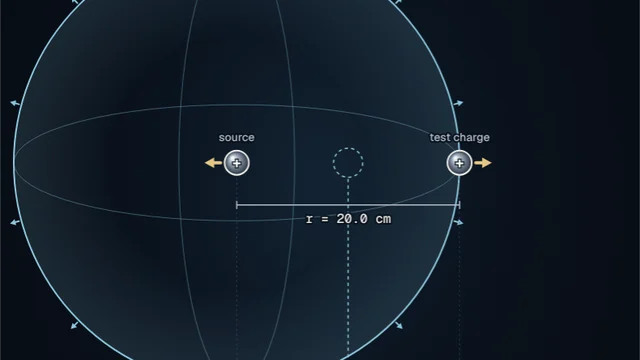 01 · Coulomb's law
Why does twice the distance mean a quarter of the force?
Move one charge away from another, read the force, and draw a sphere around the source to see where the square comes from.
Open the experiment -
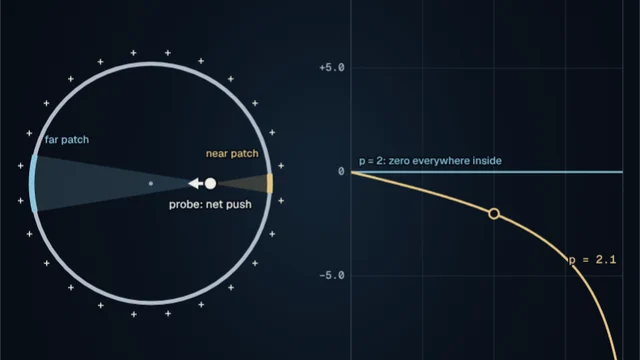 02 · Testing Coulomb's law
Could the exponent be 2.1?
Compare what-if force laws, see how uncertainty hides a small difference, and look inside a charged shell, where the answer should be zero.
Open the experiment -
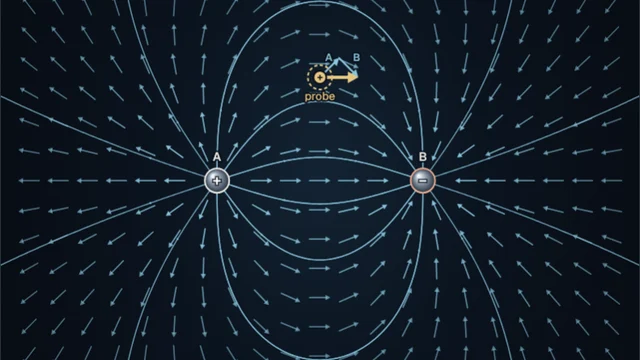 03 · Electric fields
How does one charge push another?
Carry a small test charge around fixed charges, map the push at every point, and see separate pushes add and cancel.
Open the experiment -
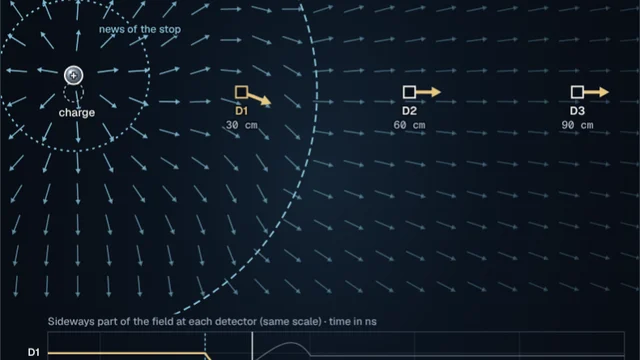 04 · Electromagnetic signals
Does an electric force arrive instantly?
Nudge a charge and watch three detectors, each reading the old field until the news arrives at the speed of light.
Open the experiment
Charge in Materials
What charging changes, and why metals, insulators and semiconductors respond so differently.
-
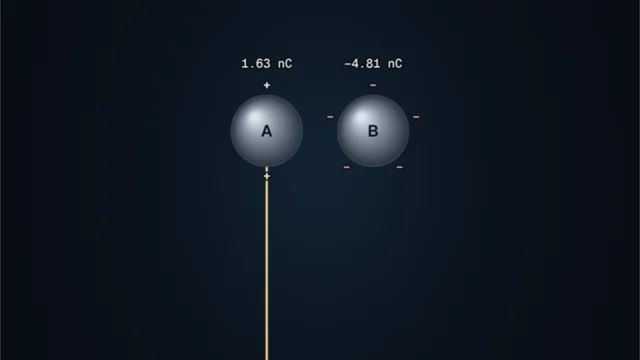 05 · Electric charge
What actually changes when you charge something?
Move electrons between two metal spheres, join them, ground one, and keep the books: the total never changes.
Open the experiment -
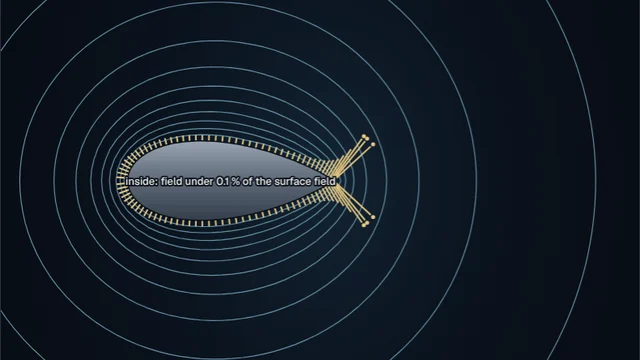 06 · Electrostatic equilibrium
Where does charge go in a metal?
Charge a ball, a rounded rod and a pointed body. See the charge crowd toward the sharper end and the field inside stay zero.
Open the experiment -
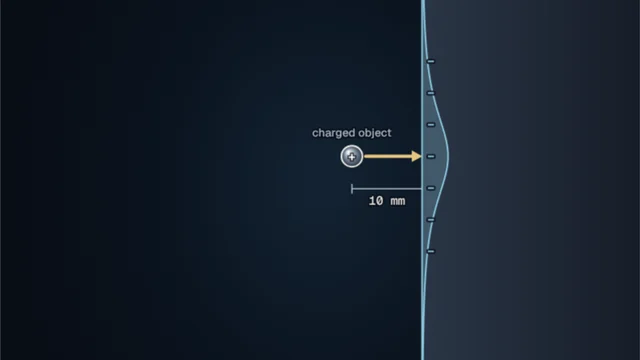 07 · Electric polarization
Why can a neutral wall attract a balloon?
Hold a charge near a neutral insulator, watch its bound charge shift, and compare with charge left on the surface.
Open the experiment -
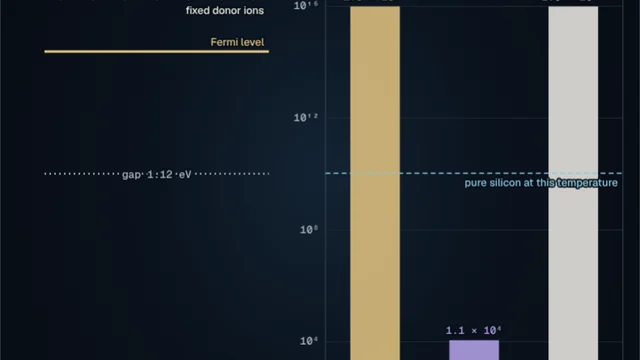 08 · Semiconductors
What lets silicon start conducting?
Count mobile electrons and holes as you change temperature and doping, then push carriers away with a gate.
Open the experiment -
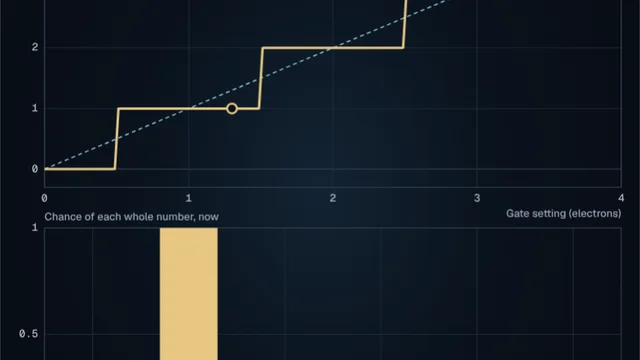 09 · Single-electron electrostatics
What changes when there is only one electron?
One electron in flight, one in an atom, one on a tiny island: three different descriptions and what decides between them.
Open the experiment
Signals & Light
Circuits, moving charges, and the waves that shaken charge sends out.
-
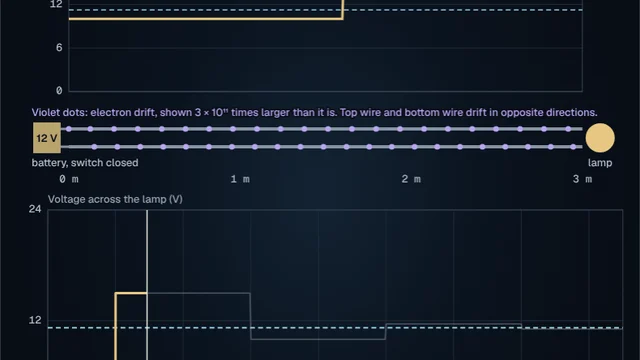 10 · Electrical signals
Why does a lamp respond before electrons travel around the circuit?
Close a switch on a long cable and compare the travelling signal with the drift of the electrons.
Open the experiment -
 11 · Magnetism
What changes when charges move?
Put a charge near a current. At rest it feels nothing; moving, it is pushed sideways without changing speed.
Open the experiment -
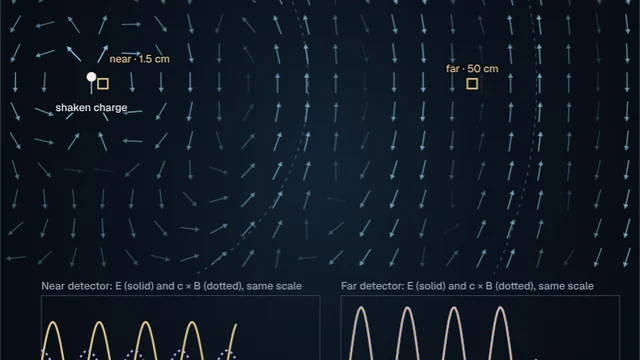 12 · Electromagnetic radiation
How can shaking charge make light?
Shake a charge and compare a detector close by with one far away: a field that breathes, and a wave that leaves.
Open the experiment